
On the bayou
The building looked like it would sink into the bayou at any second. It was a low, white rectangle with a sloping balcony, surrounded by patio furniture and fat stray cats and lemon trees frothing with unripe fruit. Across the street: Bayou St. John. A regal strip of water flanked by live oaks and stitched with bridges. It meandered between ornate yellow and pink and turquoise houses.
I eased the camper van down the gravel driveway, parked, and clipped a leash to Thelma’s collar. We got out of the van and walked under a canopy of vines to the apartment where we would be staying for three days.
The shotgun apartment had low ceilings and a dark tile floor that reminded me of a school cafeteria. There was a small den area (with a rolling cart full of art history books), which opened into the bedroom (shockingly large, exceedingly soft bed), then the hallway and bathroom (water pressure so forceful it would sting my skin), and the kitchen (ancient refrigerator, creaky back door). It was perfect.
We went for a walk around the bayou. Thelma had refused to pee since we left Birmingham that morning, and she seemed determined to keep up the streak. We crossed a bright blue metal bridge right outside the apartment. Nothing. We rounded a live oak sheltering the most charming wooden swing known to man. Nope. We peeled off the trail and went through a neighborhood bursting with particolored houses and bizarre sculptures and the occasional patch of soft and fragrant grass. Thelma refused.
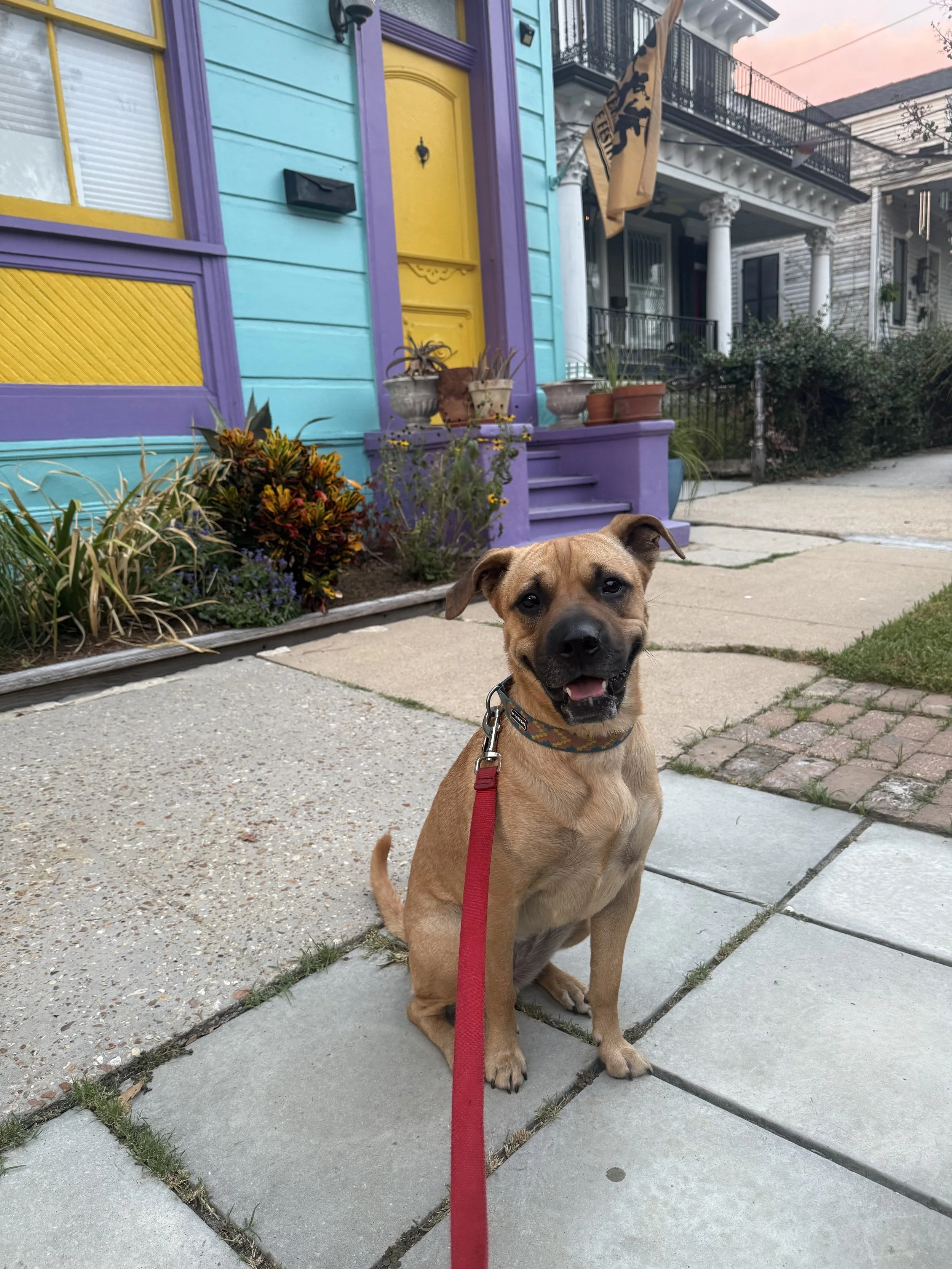
While my dog was busy not peeing, I contemplated what I’d do for three days in New Orleans. Not just three days in New Orleans—three days alone. My mind flooded with tables for one, silent strolls around swampy neighborhoods, sophisticated solo martinis. I tried to think of the last time I had been by myself.
At the time of this writing, I have been alive for 11,620 days. When I think about how many of those days I’ve spent in true solitude, surrounded by no one I know, completely entertaining myself from sunup to sundown, I’m guessing it’s around... 10? 15? I’m the oldest of five closely-aged children. When I left the house at age 18, my siblings were 17, 16, 14, and 13. My home was chaos, and I loved it. I didn’t even feel the weird, slow burn my youngest sibling experienced by living in a house that got quieter which each kid that left. One day, I was living in a loud and crowded house; the next day, a loud and crowded college dorm.
As a teenager, I always assumed I’d live alone at some point. I pictured a dusty, cramped studio apartment with wood floors and a tiny warm restaurant downstairs and a light-polluted sky framed by big smudgy windows. This is probably due to watching a pirated version of RENT during an impressionable time in my life. And while I never pined for solitude (what I really pined for was being a hot 27-year-old walking around on creaky wooden floors and making pourover coffee, then holding a mug of that coffee up to my face and looking out over some city and pulling a blanket closer around my shoulders because for some reason it’s very cold in my awesome tiny apartment), I just assumed that living alone would come to pass. It was part of life.
Except that it wasn’t. I went from living with two parents and four siblings, to living with roommates, to living with Robby. I was twenty-three when he and I moved in together. It was one of the most exciting things I’ve ever done. We Tetris-ed our too-big couch through the entryway of a charming Atlanta apartment. We bought a weird rug off Facebook Marketplace and stacked our chipped plates in the tiny cabinets and put a hundred holes in the wall that we swore we’d patch up but never did. I loved living with him then, and I love living with him now.
But today, I realize the price I’ve paid for this joy is the skill of solitude. If being alone is a muscle, mine is severely atrophied, or perhaps never developed to begin with. The older I get, the more important it seems to know how to be alone, and to get the opportunity to do so.
And what a tiny, delicious opportunity I had: three whole days in my favorite city in the world.
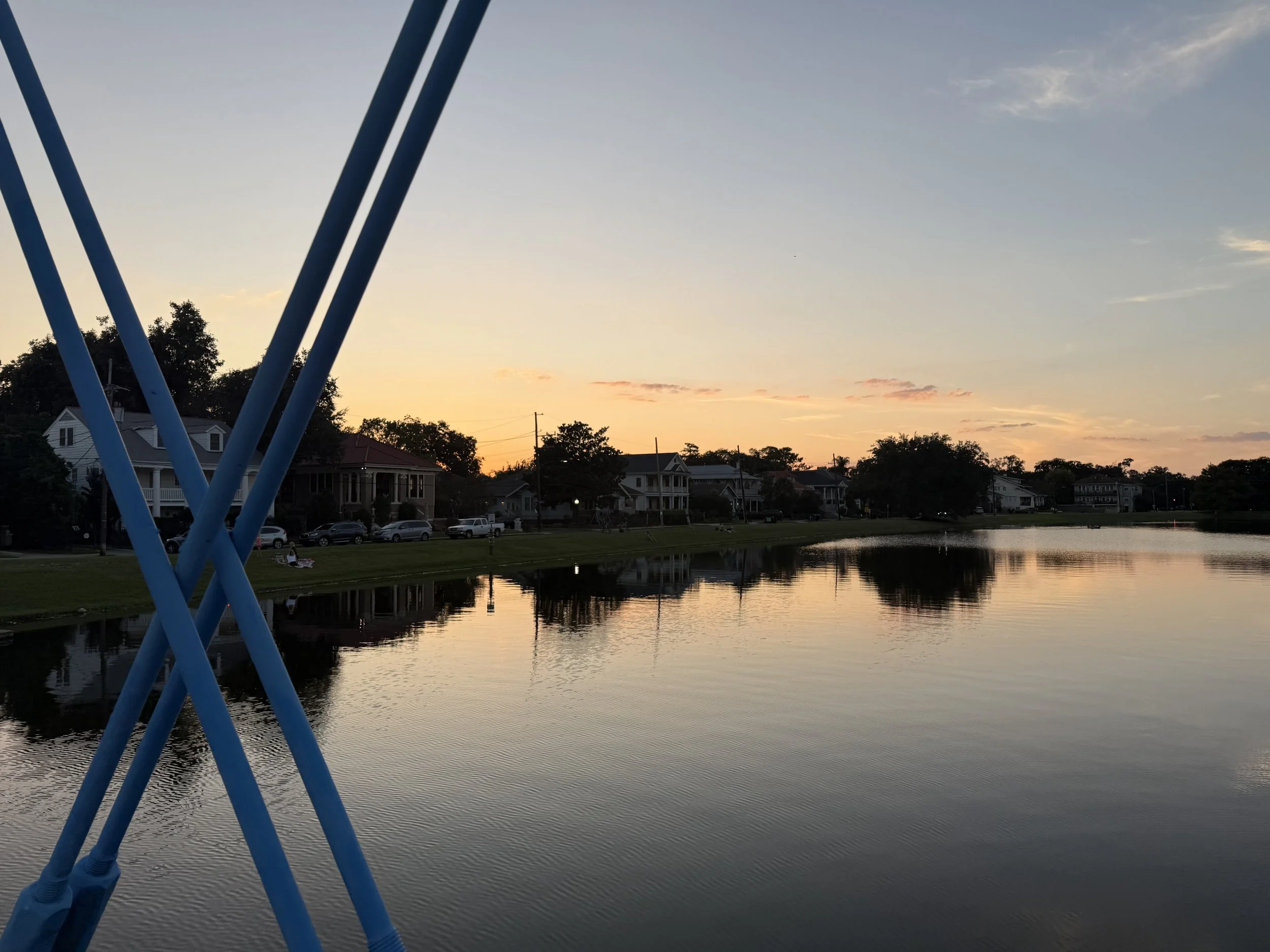
Thelma and I went back to the apartment, her still refusing to pee, and I put on a sundress and sneakers and walked to a Latin fusion restaurant a friend had recommended. I sat on the patio and ordered a cartoonishly large pile of seafood nachos. I clicked through my Kindle and shoveled perfectly seasoned shrimp into my mouth. The Bayou St. John neighborhood washed around me—a stream of flamboyant outfits and friendly dogs and less-friendly dogs and bikes with speakers duct taped to their crossbars, blaring artists I could never quite place.
Of the few solo restaurant meals I’ve eaten in my life, this was the first one where I felt completely comfortable. In fact, I would have rather eaten by myself than have been there with someone else. This feeling of being alone, and being full in my aloneness, was entirely foreign. I’m sure there’s a word for it in a different language.
*
Two days before, in one of my less-fine moments, I was mad at Robby for a hurricane. Or rather, I was mad at the fact that there was a hurricane off the coast—two, actually—and that he was reacting in a sensical way that threatened my particular plans. We were in our friend’s guest room in Birmingham, Alabama, and he was gesturing at the storm radar on his phone.
“The top one’s coming right for us,” he said. The orange and red blur looked like a fresh wound, and the predicted path stretched off of it in a pale, fish-like shape, its mouth swallowing our home on the coast of North Carolina. I pictured our little white house standing proudly in the face of driving rain, as it had done for over a hundred years.
“I’m not sure I should go back to Wilmington,” he said.
Birmingham was the first stop on our month-long road trip. We had no destination in mind, only the contours of a route that amounted to a vague dotted line across the southwest. We have a camper van—a 2019 Ram Promaster named Wilma—that we lived in from the summer of 2021 to the summer of 2022, which was maybe the best year of our lives. Since then, Wilma has been rotting in our driveway, going only on the occasional weekend excursion. We were all overdue for a joyride.
We were in Alabama for our friends’ wedding, after which Robby would catch a ride back to North Carolina to play in beach volleyball tournaments. I planned to take this opportunity to go to New Orleans on a rare solo trip. After three days, he’d fly down and meet me, and we’d continue on our journey.
“I don’t want to fly in that,” he said, moving his phone closer so I could watch the northernmost hurricane twirl its pixelated skirt. “And the tournaments will probably be cancelled, anyway.”
A couple months ago, I would have welcomed this turn of fate. I had initially hoped Robby and I would go to New Orleans together and had been annoyed at his soulful commitment to recreational volleyball. I’d pictured us wandering in and out of jazz bars and gorging ourselves on seafood. We’d have to work our remote jobs during the day, sure, but we could pick a new neighborhood to explore each night. But as soon as he made it clear he’d be going back to Wilmington for a few days, the trip reformed in my mind. I’d take the dog and explore the city alone. Robby didn’t even like New Orleans.
“Great,” I snapped. “I guess I’ll never go anywhere by myself.”
This was unfair. Not only is it bad to guilt trip someone for trying to avoid a hurricane, but Robby has never kept me from doing what I want. Problem was, this was the first time I’d actually wanted to travel by myself. To be honest, the thought had never really occurred to me before this trip. My usual calculus was: If I’m going to go through the trouble of planning an adventure, of finagling my work schedule, of packing and heading somewhere new and eating and drinking and exploring, why wouldn’t I want to go with the person I love?
It was at that moment—of me snapping at my husband for not wanting to travel toward a storm—that I realized how closely I had come to treasure this tiny trip alone, the promise of three silly days during which I had no plans at all.
I tried to course correct. I said I was sorry for my reaction, the weather wasn’t his fault, and obviously I didn’t want him to travel home, sit inside while volleyball was canceled, then fly to New Orleans in the dregs of a hurricane. Of course I’d rather him come with me.
But the next morning, as the hurricane ricocheted off the coast and spun harmlessly into the Atlantic, I packed the van, kissed Robby goodbye, and headed south.
*
Full of seafood nachos, I carried the feeling of alone-wholeness back to the apartment. Thelma greeted me at the door, and we went for another stroll around the bayou. This time, surely, she would pee. The sun was quietly drawing light back into itself, leaving behind a pale blue sky that warmed to a dusty pink. A group of thirty-somethings were having a picnic on the other side of the water. Every few minutes, a new bike would arrive. Its rider would add the bike to the pile and make a round of hugs. The music coming out of the old-fashioned boombox would change, another bottle of wine would open with a pop.
Thelma again refused to pee, and we went back to the apartment. It was only 8:30, but I was exhausted. I started getting ready for bed—something I likely wouldn’t have done if I were traveling with Robby or a friend. I’d urge us to go for a glass of wine or get a ride to a different part of town and walk around. Being by myself in an unfamiliar place, these options did not appeal to me. I locked the doors, took a shower, climbed into the comically large bed, and pulled up a movie on my laptop. As the film started, visions of a man breaking into the apartment swam into my mind. If he were quiet—if he knew the code to the lock or was able to jimmy the door open gently—would I even wake up?
I got out of bed and checked that all the windows were locked. I pushed a coffee table against the front door, then angled a chair against the back door. If someone came in, they’d at least make noise. I placed my knife on the bedside table.
It fascinates me that most men don’t systematically think about strangers attacking them. For me, nighttime in a new place is a small but constant mental exercise, a perpetual scan that takes up real estate in my consciousness. I sometimes fantasize about how it would feel to stay in a sweet, rickety apartment without question, to be rid of my tenuous relationship with the dark.
I take for granted the fact that I’m almost always sharing a space with Robby, which makes the uneasiness evaporate. But on the rare occasion he’s not there, the fear crashes back into focus. As I fiddled with the window locks, I wondered if I’d feel more comfortable in new places if I traveled alone regularly, or if this uniquely female fear just never goes away.
Satisfied with the furniture placement, I played the movie. Afterward, I clipped the leash on Thelma’s collar and—after shoving aside the coffee table lodged against the door—we strolled along the bayou for the third time that day. This time, finally, Thelma peed.
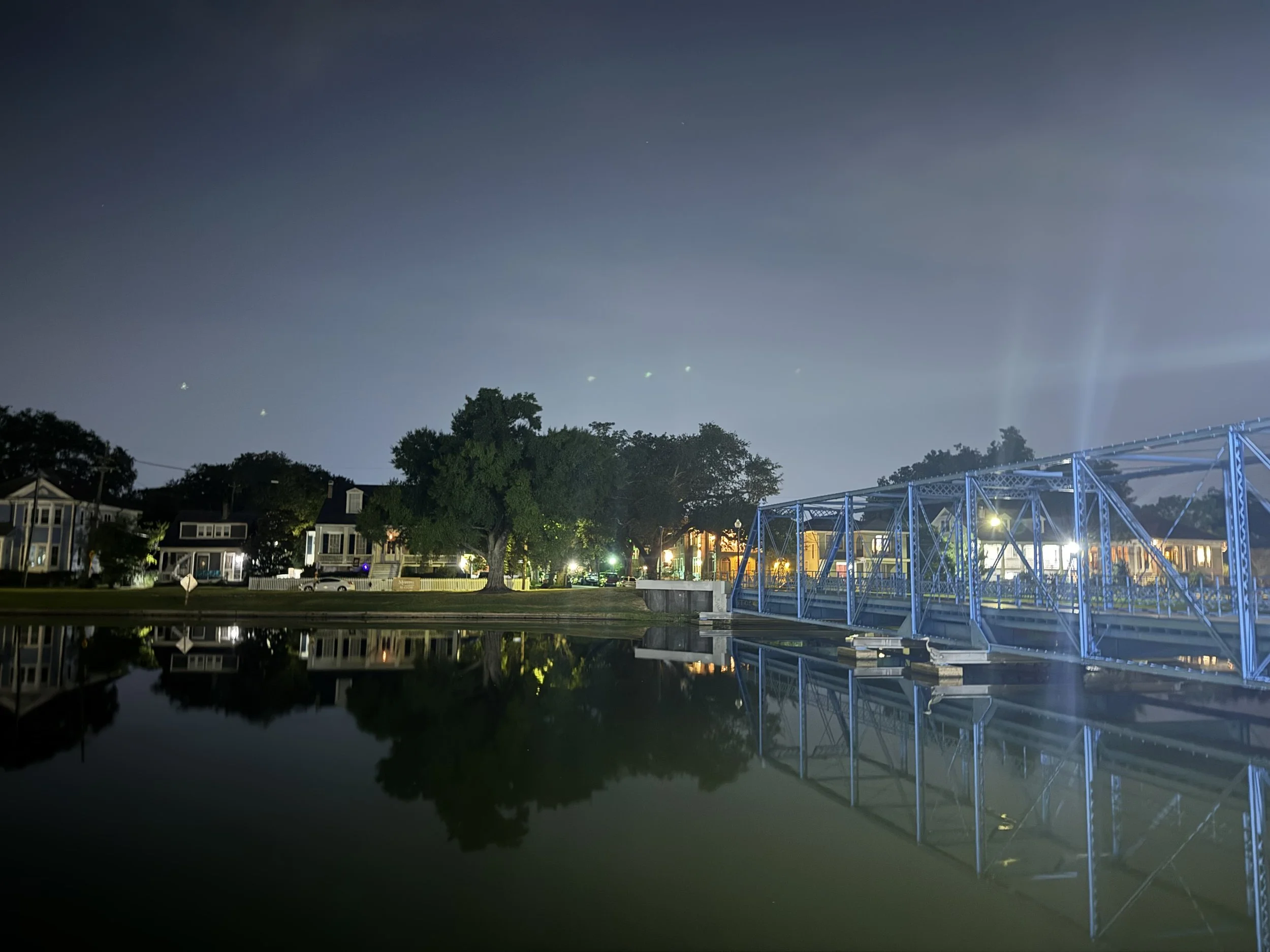
The moon was gigantic and close. We meandered along the water, which reflected the sky like a dark blue scar, then turned around. On the way back, Thelma paused. She was looking across the bayou at something I couldn’t see. She sat. Usually, if Thelma sits mid-walk, it means she’s fixated on something. Her forehead wrinkles mash into one another and her body goes stiff. This time, though, she seemed… casual. She didn’t keep her sight trained on the same spot across the water; she just looked around under the moon. I got the feeling she wanted to enjoy the view together, so I sat beside her.
I put my arm around her, and we stayed like that for a while. The sky sunk to a deeper ink. Thelma, quiet by nature, had an exquisite serenity about her. The moon drifted up and away like a glowing balloon, and we had nowhere to be.
*
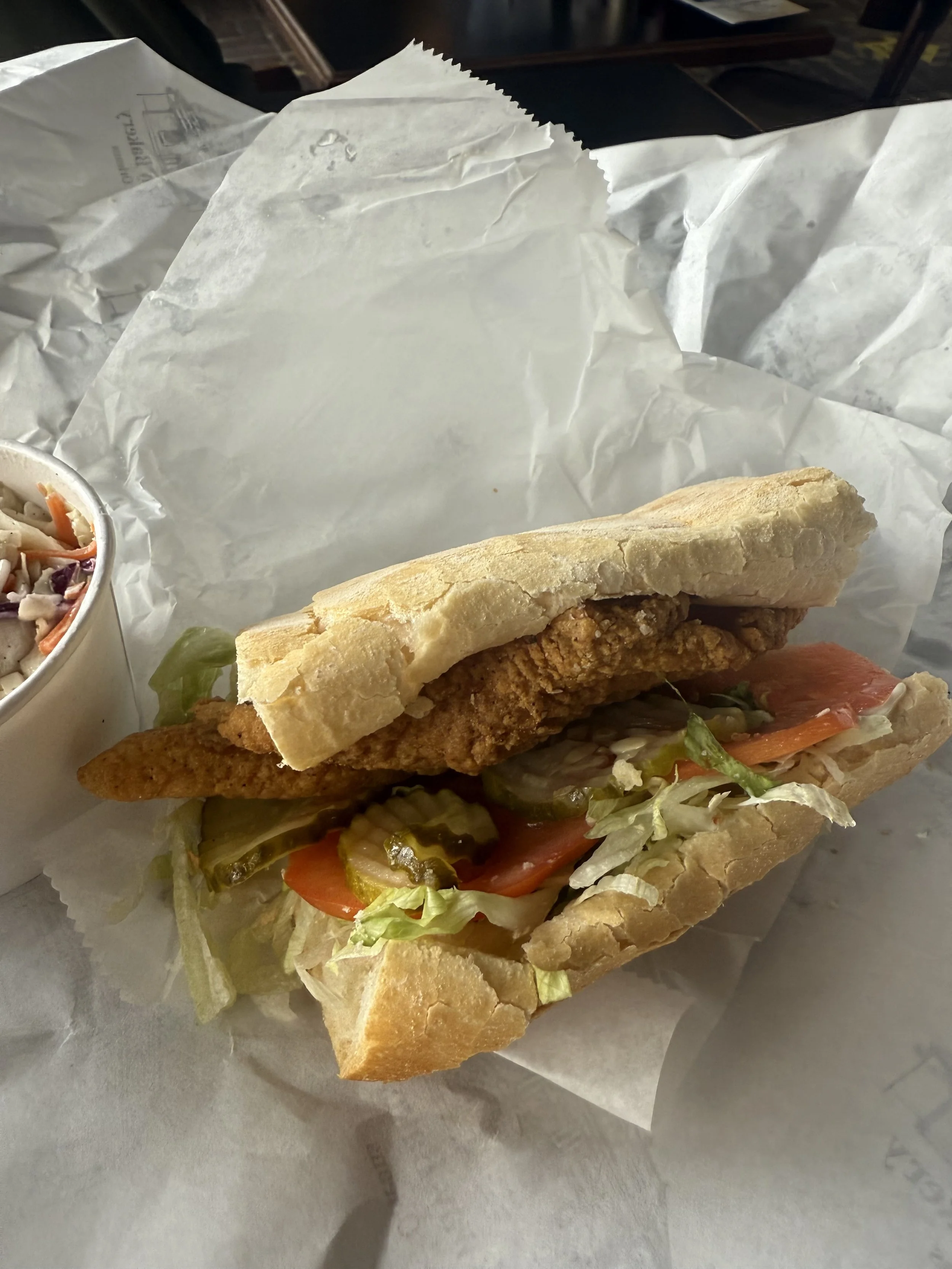
The next three days held everything I’d hoped: gourmet hush puppies, a killer martini, strolls through bizarre vintage stores, a brain-melting Vietnamese restaurant I found by accident, a po’ boy so good I almost cried. At one point, I was walking along Bourbon Street after dinner. I reflected on the first time I’d visited this street at age eighteen, and the handful of nights—beautiful nights!—I’d spent here since. I saw outlines of myself two years ago, standing on various balconies during Mardi Gras. I saw glimpses of the bizarre costume I cobbled together one Halloween, remembered how I’d leaned on the shoulders of strangers around a grand piano as we sang American Pie at two in the morning. Now, Bourbon Street was quiet and draped in sunset. An old couple held hands and shuffled down the center of the road. I was carrying a Kindle, of all things, and felt the sensation I feel every time I come here: peace.
Bourbon Street is not known for peace. But as a person who’s always reaching for stimuli, I find comfort in the tangle of noises and colors that this street serves up. When my senses are completely engaged, my mind quiets down. I was pleased to find that even though this version of Bourbon Street–early October, soft orange sky, Kindle in hand–was quieter than my past visits, I felt the same degree of joy. I could not stop smiling.
*
Admittedly, I didn’t spend the entire trip alone. I hung out with Gab, a warm, brilliant person I met through mutual friends early last year. She lived close to where I was staying and kindly showed me a couple of her beloved spots. On my last night in New Orleans, she invited me to come to a show with her and her friends.
The venue was a dive bar with black walls and red lights and wooden hands mounted to the wall by their wrists, each holding a candle. The opening act, NNAMDÏ, took the stage. NNAMDÏ is a captivating Chicago-based solo artist whose style is well outside my limited music vocabulary. All I can offer are untechnical snippets: The songs were built on layered guitar and keyboard melodies that emanated from a stack of gigantic speakers. NNAMDÏ’s own voice was folded on top itself several times over, taking on different registers and personas. Electronic elements swung into and out of the songs like headlights down a dark road.
I was enchanted by his singular sound, but what struck me most was NNAMDÏ’s relationship to his music. He wasn’t just singing or playing; he was building. Each song was a new planet he became lost in. The audience watched him construct worlds from the inside out, from the core to the atmosphere.
When NNAMDÏ was deep into a song, he’d start to dance. His movements were sudden but sure. At one point, he jutted his elbows out, his fists in front of his chest. He spun in a tight circle on the stage, the loops growing faster as the music swelled around him. I imagined him as a kid making music in his room, fiddling on a guitar until the sound was just right. I realized that the audience didn’t need to be there at all; this was between a man and the piece of himself he’d managed to bottle through sound. This was between a person and the universe.
I’m in awe of those who regualrly access and share the purest sense of who they are. Even when I’m dancing wildly or laughing loudly or wandering aimlessly down Bourbon Street, part of me is tracking the reactions of those around me, or wondering how I actually look, or narrating or mythologizing the thing I’m doing, in real time. That voice has gotten quieter over the years, but it’s there, gently tugging my consciousness away from the present. I’m rarely centered.
A three-day trip to New Orleans didn’t change this. However, it reminded me that while my life is full of people I love, I don’t need them to make me feel whole. The feeling of self-sufficiency, of alone-wholeness, is a gift I’ll spend my life rediscovering. It’s a gift only one person can give.